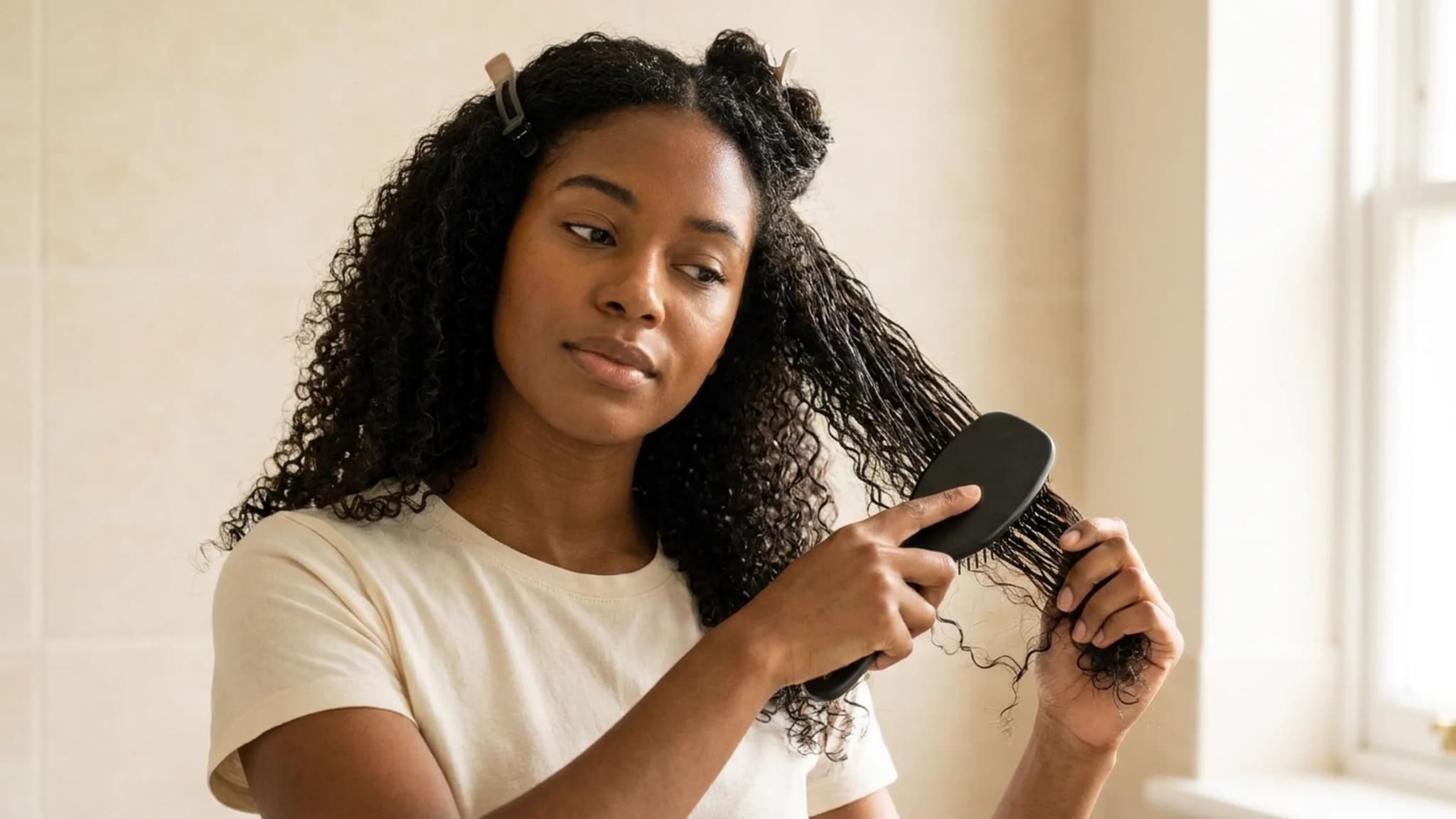
Your curls only come apart in the shower, and every article you read says brushing wet hair is the worst thing you can do. That advice was written for straight hair. On curls and coils the research points the other way, as long as there's conditioner in.
Is it bad to brush wet hair?
For most straight and wavy hair, yes, it's riskier than brushing dry. The American Academy of Dermatology says hair is delicate when it's wet and recommends a wide-tooth comb instead of a brush.
Why wet hair breaks more easily
Water gets inside the hair fibre and loosens the bonds that hold it stiff. The strand stretches more, and it breaks sooner.
A 2022 tensile study in the International Journal of Cosmetic Science measured this on untreated hair. Dry hair took roughly 20% more stress to break than wet hair, and wet hair stretched further before it snapped. A 2015 review in the International Journal of Trichology puts the safe limit in plain terms. Wet hair can stretch by about 30% of its length without damage. Past that, up to 70%, the changes are permanent.
Drag a brush through wet hair and you're pulling on a strand that's already stretched and easier to break.
Why curly hair is the exception
On a curl, most breakage starts at a tangle, and dry curls tangle far more than wet ones.
Why do dry curls snag?
Curls wrap around each other. The tighter the curl, the more tangles form and the more complex they get, and every loop is a spot where a strand bends hard and can snap.
Hair scientists Kamath and Robbins reviewed the research on combing breakage in the Journal of Cosmetic Science in 2011. Highly coiled hair needs significantly more force to comb or brush when it's dry than when it's wet. It also breaks more when dry. Water relaxes the curl a little, which cuts down the tangles.
Straight-to-wavy hair shows the opposite pattern. The general rule was built on that kind of hair.
Conditioner makes wet brushing safe
Water alone loosens the curl, but it doesn't give slip. Conditioner lets the strands slide past each other. The 2015 review notes that conditioners and leave-ins lower the friction between fibres, which makes hair easier to comb, and the 2011 review cites work showing conditioned hair breaks less in combing and brushing.
The AAD adds that people with curly or thick hair should put conditioner through the full length, not just the ends.
The worst time to detangle: towel-damp hair
You've rinsed, wrapped your hair in a towel, and now you spot a knot you missed.
Your hair is still wet, so it's still weak. The slip is gone. You have the low strength of wet hair and the friction of dry hair at once, and the curl is starting to tighten back up as it dries.
Kara knew this stage well before she found a brush that worked for her:
"I'd pre-detangle with a wide tooth comb, then RE-detangle with conditioner and a wet brush in the shower, just to have to detangle again once I got out of the shower."
Found a knot after rinsing? Don't fight it. Put a palmful of conditioner or leave-in on that section first, then work it out. The AAD's towel rule fits here too: press water out with a towel or T-shirt rather than rubbing, since rough towel-drying damages hair.
How to brush wet curly hair without breakage
If you want the bigger picture, see where detangling fits in wash day or a full wash-day routine. Here's the detangle itself.
Time: 20 min. What you need: Rinse-out conditioner, Flexible detangling brush or wide-tooth comb, Hair clips.
- Load the conditionerWork conditioner through soaking-wet hair from root to tip, and use more than feels necessary. Knots catch wherever a strand was missed.
- Section the hairSplit your hair into four to eight sections and clip away the ones you aren't working on. A small section keeps tangles from piling into each other.
- Start at the endsHold a section near the middle and detangle the last few inches first. Then move up in short steps until you reach the root. Working up means each pass only meets the knots below it, and the AAD gives the same direction for combing.
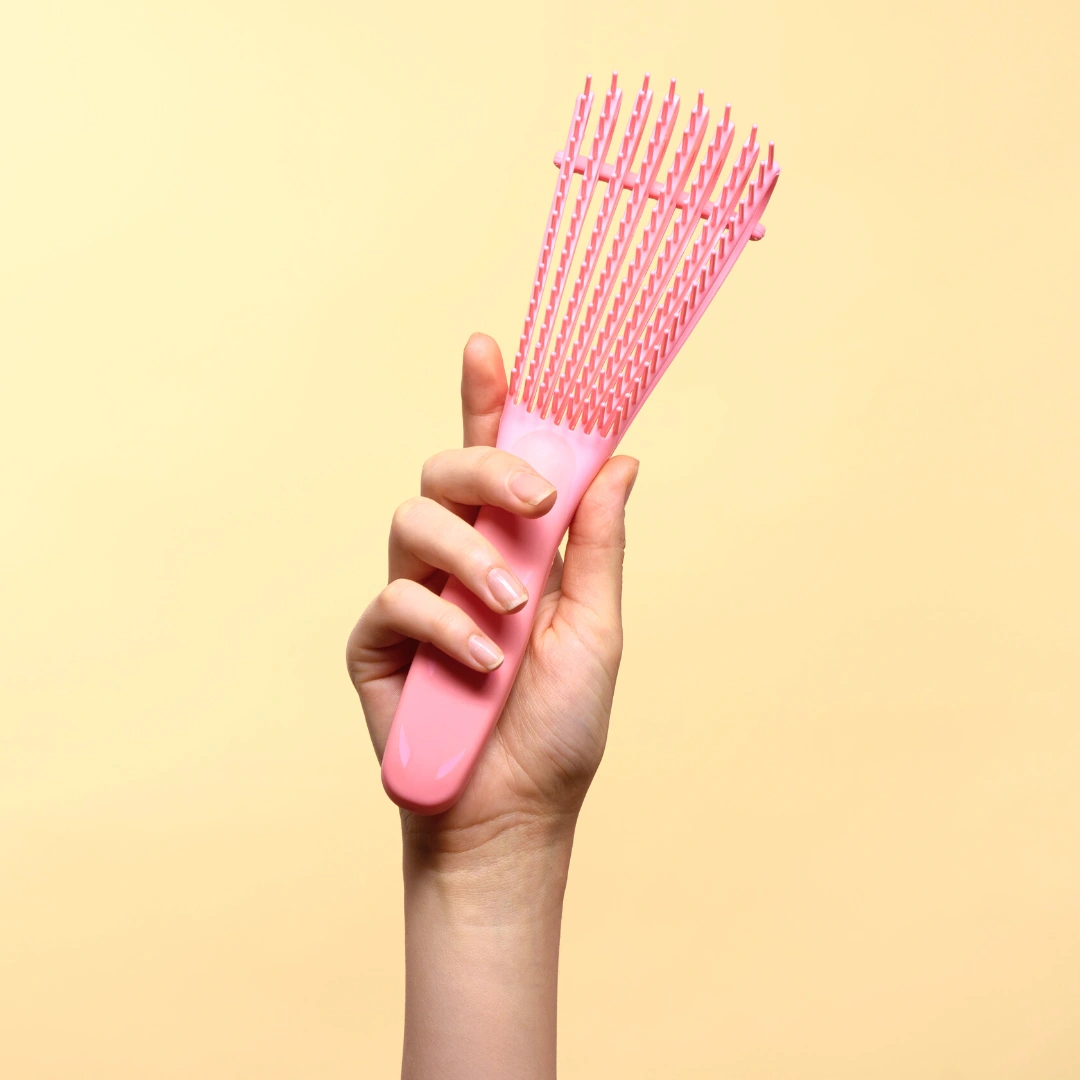
- Use a tool that givesUse a flexible brush or a wide-tooth comb. Kamath and Robbins note that combs or brushes with more space between the teeth or bristles lead to fewer tangles and fewer broken hairs.
- Stop at the second snagCaught on the same spot twice? Stop pulling. Add more conditioner, separate the knot with your fingers, and go again. Yanking through a tangle snaps strands.
One of our customers landed on this method herself. Natacha uses the Easy Detangler Brush and had this to say:
"I brush in the shower with conditioner still in my hair, starting at the bottom and working up. After a few passes through the worst part, these brushes glide through my hair effortlessly. I like how it separates my ringlets, making my hair look better and not frizzy. My daughter has claimed the second brush for her wavy, long hair. Not only does it work for her, she can actually brush through all of her hair without our help."
If you're the one detangling a child's hair on wash day, the same steps apply. Smaller sections just go faster.
For direction and pressure once your hair is dry, read which direction and how hard.
Do you need a brush at all?
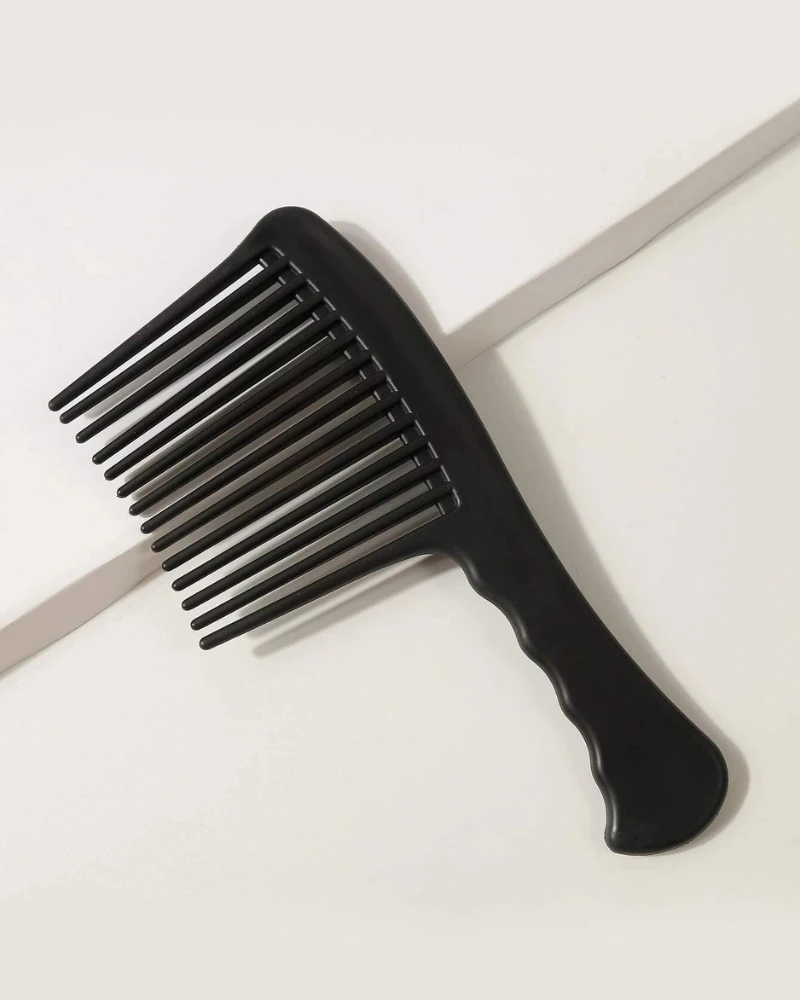
No. The AAD's own recommendation for wet hair is a wide-tooth comb, and the British Association of Dermatologists lists a wide-tooth comb or a soft brush with widely spaced bristles for Afro-textured hair. On tight coils, your fingers make a fine first pass too.
A brush is faster, that's all. On thick or very dense hair, a flexible brush moves through a conditioned section in fewer passes than a comb does. It doesn't make detangling any safer than a good comb used slowly. If you'd rather keep it simple, a comb does the job.
Frequently asked questions
Next wash day, keep the conditioner in until the last section is done, and keep a little extra by the sink for any knot you find after rinsing. A knot that survives the shower is far easier with fresh slip on it.